Selected work in authorship, transfer & translation
A close look at how raw subject-matter input becomes documentation people can act on — how technical training is designed and delivered, how quality is held to a line, and how legally and clinically sensitive text is carried faithfully across languages.
Drawn from fourteen years across semiconductor, embedded vision, defence communications, financial software, and legal and medical localization. Every example below is abstracted: organisations, individuals, reference numbers, lot codes, and any personal data have been removed or replaced with neutral stand-ins.
01 — Technical Authorship
Turning SME brain-dumps into documentation a stranger can follow
How raw engineering input is gathered, interrogated, restructured, and written for the person who actually has to act on it.
Turning SME brain-dumps into documentation a stranger can follow
How raw engineering input is gathered, interrogated, restructured, and written for the person who actually has to act on it.
The starting point
Subject-matter experts rarely hand over a document. They hand over a half-finished spec with three undefined acronyms, a wiki page last touched two years ago, a recorded screen-share, and a sentence that begins "basically you just…" Authorship is the discipline of converting that into something a person who was not in the room can read once and do correctly.
How input is gathered
- Source triage. Everything available — specifications, engineering write-ups, drawing packages, ticket threads, prior revisions — is collected first and ranked by authority, so the document is built on the current source of truth rather than the loudest voice.
- Structured SME elicitation. Interviews run from a prepared question set built around what the reader needs to decide and do, not what the expert finds interesting. The recurring probe is "and then what happens — and what happens if it doesn't?"
- Gap log. Every unanswered question, undefined term, and unstated assumption is tracked openly and closed with a named owner, so nothing silently defaults to a guess.
The authoring move
The core transformation is from description ("the system supports rollback") to instruction ("to roll back, do X; you will know it worked when Y; if Z appears, stop and do W"). Below is a representative before/after, fully reconstructed and de-identified — the kind of edit applied across user guides, configuration procedures, and operational runbooks.
The service can be reverted to a previous good state if needed. It uses the snapshot mechanism. Note that there are some prerequisites and it should not be done while jobs are running as this may cause issues.
Roll back the service to the last good snapshot. Before you start: confirm no jobs are running (Status must read Idle). Running a rollback during an active job can corrupt the job queue. 1 — Open the snapshot list and select the most recent entry marked Verified. 2 — Select Restore; the service restarts automatically. You are done when Status returns to Idle and the version banner shows the snapshot date.
The improvement is not stylistic. The raw input names a capability; the authored version makes the action safe to perform unsupervised — it surfaces the precondition the SME left implicit ("should not be done while jobs are running" becomes a checkable state), defines success, and handles the failure path. That is the value added on top of the SME's knowledge.
Standards applied
Topic-based, single-source-of-truth authoring (DITA / structured Markdown / Docs-as-Code) so one corrected procedure propagates everywhere it is reused; minimalist instruction design so the reader is never made to read past what the task requires; and a consistent terminology set enforced across the deliverable set rather than per-document.
Across release-cycle documentation sets, this approach has been used to take SME-authored drafts to release quality as part of a publications team — measured by reviewers signing off on technical accuracy, and by support deflection: procedures that stop generating "how do I actually do this" tickets.
02 — Knowledge Transfer & Course Development
Designing technical training, not just writing it down
From working out what the training has to achieve, through building the course, to teaching the first run and reducing how much it needs fixing afterwards.
Designing technical training, not just writing it down
From working out what the training has to achieve, through building the course, to teaching the first run and reducing how much it needs fixing afterwards.
Where this differs from authorship
A manual answers "how does this work?" A course answers "can this person now do the job?" That shift — from reference material to proven capability — is what developing a technical course is for. It decides what gets taught, in what order, how learners practise it, and how you confirm they can actually do it. It is the work behind enabling both internal staff and external customers on complex technical software.
Scoping the curriculum
Before any content is written, the shape of the course is worked out: what the training has to achieve, and for whom.
- Start from the gap, not the topic list. Development begins with a plain question: what must the learner be able to do afterwards, and where are they falling short now? The course is built to close that gap — not to cover everything a subject-matter expert finds interesting.
- Two audiences, two courses. The same product needs different training for different people: those who use it day to day (task fluency) and those who configure, deploy, and troubleshoot it (how it is built and how it behaves). Treating them as one audience is the most common reason technical training fails.
- Agreed with the people who own the product. What the training has to achieve is settled with product and engineering teams, so the course tracks how the system is really deployed and what the business actually needs — not the org chart.
Building the learning experience
Course development works best as a deliberate cycle rather than ad-hoc writing: work out what learners need, set clear objectives, build the materials, deliver them, then check what worked and revise. There are well-known formal models for this, and informed opinion that the strictly linear ones are too rigid in practice; the point is not allegiance to any one model but the shared common sense beneath them all — adults learn by doing, by connecting new material to what they already know, and by seeing why it matters to their work.
Complex technical material — systems, environments, deployment models, and end-to-end solution workflows — becomes a deliberate teaching sequence built on clear, checkable objectives: explain the concept, show it done, let the learner work through it with guidance, then have them do it unaided against a realistic task. Technical accuracy is confirmed with the relevant engineers and subject-matter experts as the course is built, not assumed from a first draft.
- Written once, delivered many ways. Each course is developed from a single structured source and produced for the formats the audience needs — self-paced study and instructor-led or virtual instructor-led delivery — so the versions stay consistent as the product changes.
- The right tool for the job. Course materials are produced with whatever authoring and capture tools the work actually calls for, chosen to fit the content and the audience rather than out of habit — the tool serves the learning goal, not the reverse.
- A dependable delivery setup. Where a course needs a hands-on component, the practice setup is coordinated with the relevant technical people so it is ready and works reliably for delivery — a supporting, collaborative role rather than infrastructure ownership.
Delivery and iteration
A course is only proven when it is delivered — but the goal is to need as little correction afterwards as possible. Most of that is earned before delivery: settling objectives with the people who own the product, confirming technical accuracy with engineers and subject-matter experts as the material is built, and walking each exercise through end to end so it works as written. A short dry run or pilot with a real reviewer or small group catches the weak transitions and under-specified steps while they are still cheap to fix, rather than in front of a full cohort. What feedback does come back after delivery then refines a course that already works, instead of repairing one that didn’t — and other course developers are mentored through that same review discipline so quality and readiness stay consistent across the catalogue. Through all of it, a course has to do two things at once: hold attention and build capability. Engagement is not decoration — visuals, hands-on practice, well-placed humour, and a bit of fun are what keep learners with you long enough to actually learn; a course that loses the room teaches nothing, however accurate it is.
This is the full scope of effective technical course development: agreeing with product and engineering teams what the training must achieve and who it is for; setting up the means for delivering the course and letting learners practise; selecting and using the right tools to write courses for both self-paced and instructor-led delivery; teaching the first runs in person; and mentoring other course developers to keep quality consistent.
03 — Quality Assurance
Holding a deliverable to a line, every line
Linguistic accuracy, terminological consistency, and procedural soundness — checked systematically, not impressionistically.
Holding a deliverable to a line, every line
Linguistic accuracy, terminological consistency, and procedural soundness — checked systematically, not impressionistically.
What QA actually checks
"Proofreading" catches typos. Documentation QA is a different instrument: it asks whether the text is accurate, consistent, and reproducible — whether a competent reader following it would arrive where the document promises.
- Technical fidelity. Does each statement still match the current source? Reviewed against specifications and SME confirmation, not against the previous draft.
- Terminological consistency. One concept, one term, everywhere — enforced against a maintained glossary across the whole set, so the same component is not a "module" on page 3 and a "unit" on page 11.
- Procedural soundness. Every procedure is walked step by step for logical consistency, completeness, and a defined success state. Steps that cannot be performed as written are flagged, not smoothed over.
- Gap remediation. Missing prerequisites, undefined terms, and absent failure paths are logged and closed — the same discipline applied to authored and to inherited documentation.
How it is run
QA is a defined pass with a checklist and a tracked issue log, not a final read-through. Each finding is recorded with location, severity, and resolution owner; nothing is "fixed quietly." On translated material the same rigor applies bilingually — accuracy against source, consistency against the approved termbase, and register appropriate to the document's legal or clinical weight.
"Configure the device and restart. The system will be ready." — no success criterion; "ready" is unverifiable; the restart prerequisite is unstated.
"Apply the configuration, then restart the device. The device is ready when the status LED is solid green and the dashboard reports the new configuration version. If the LED blinks amber, the configuration did not apply — repeat from step 1."
Used as the release-gate review on documentation and localization sets — peer review plus governed quality control — so that what ships is traceable, internally consistent, and reproducible by its intended reader.
04 — Sworn & Certified Translation
Carrying legal and clinical weight across the language line
Two domains where a mistranslation has consequences: criminal-court correspondence and medical-device field safety. Authentic method, fully de-identified examples.
Carrying legal and clinical weight across the language line
Two domains where a mistranslation has consequences: criminal-court correspondence and medical-device field safety. Authentic method, fully de-identified examples.
The discipline
In legal and medical translation the translator has no licence to improve, soften, or clarify the source. The obligation is faithful transfer of legal effect and clinical meaning into natural, register-correct target language — preserving binding force and procedural terms exactly, while reading as though originally drafted in the target. The method below holds for any language pair; the worked examples happen to be English into Romanian, and are reconstructed and stripped of every name, address, reference number, and personal detail.
Legal — court correspondence (EN → RO)
The challenge here is that English and Romanian criminal procedure do not map term-for-term. The technique is to render the Romanian functional equivalent and retain the English term in brackets on first use, so the document is both legally intelligible in Romania and traceable to the original proceedings.
In the meantime, [the client] has been granted conditional bail with the following conditions: not to enter any large commercial venue selling high-value items; not to contact any co-defendant in a public place.
Între timp, [clientului] i s-a acordat liberarea provizorie sub control judiciar cu următoarele condiții: să nu intre în niciun centru comercial complex care comercializează bunuri de valoare ridicată; să nu ia legătura cu niciun co-inculpat în locuri publice.
The deliberate choices: conditional bail becomes “liberarea provizorie sub control judiciar” — the functional Romanian institution, not a literal word-for-word rendering that would carry no legal meaning. Co-defendant → “co-inculpat”, the correct procedural term. Binding modality (“not to”) is preserved as the imperative-subjunctive “să nu”, which carries the same obligatory force in Romanian legal register.
Legal — preserving the consequence clause
Failure to attend Court on time, without a reasonable excuse, will result in a Warrant being issued for your arrest.
Neprezentarea la instanță la timp, fără un motiv întemeiat, va conduce la emiterea unui mandat de arestare.
The certainty of the English future (“will result”) is preserved as “va conduce la” — not the conditional “ar putea”. In a legal warning, downgrading certainty to possibility would materially change the document's effect. That distinction is the entire job.
Medical — field safety notice (EN → RO)
Medical-device correction notices are regulated text: device names, the word "urgent," and the nature of the action must transfer exactly, with no euphemism that could reduce perceived urgency.
Urgent Medical Device Correction. This notice is to advise you that the manufacturer is initiating a voluntary correction related to the Instructions for Use (IFU).
Corecție medicală de urgență. Această notificare se efectuează pentru a vă informa că producătorul inițiază o corecție voluntară aferentă Instrucțiunilor de utilizare (IdU).
Domain conventions drive the choices: Urgent … Correction → the established Romanian regulatory phrase “Corecție medicală de urgență”; the abbreviation is localised (“IFU” → “IdU”) but introduced in full on first use so a clinician can map it back. “Voluntary” is kept — omitting it would misstate the regulatory nature of the action.
Sworn certification
For sworn use, the translation carries the authorised translator's certification, stamp, and statement of conformity, and the layout is rebuilt to mirror the source so the document holds its standing for notarial, institutional, and judicial submission.
Applied to high-stakes legal correspondence and to medical-device field-safety and reprocessing documentation — domains where the acceptance criterion is not "reads well" but "carries the same legal and clinical effect as the original, and is accepted by the receiving authority."
05 — Web Design
Design that carries the content rather than competing with it
Where authorship discipline meets the browser: structure, clarity, and message before ornament.
Design that carries the content rather than competing with it
Where authorship discipline meets the browser: structure, clarity, and message before ornament.
The approach
This site is itself the case study. It was built content-first: the message and information architecture were settled before a single visual decision — the same principle that governs the documentation work, where the reader's path comes first and the styling serves it.
- Content-led structure. Sections, hierarchy, and navigation derive from what needs to be communicated and in what order — not from a template's available slots.
- Restraint as a design choice. A tight type system (one serif for voice, one sans for clarity), a disciplined palette, and generous whitespace, so attention lands on the words.
- Hand-built and accessible. Semantic HTML, keyboard-operable interactive elements, responsive from narrow mobile to wide desktop, and print-aware.
- Performance as courtesy. No heavy frameworks where none are needed; fast to load and legible on a poor connection.
From concept and copy through layout to launch, the site is built around what there is to say — the same audience-first instinct that drives the authorship, training, and translation work, expressed in a different medium.
06 — Desktop Publishing
Re-engraving sacred chant to printed-book standard
Re-engraving an out-of-print 1943 hymnal for republication — keeping a rare, endangered sacred chant tradition legible, chantable, and alive.
Re-engraving sacred chant to printed-book standard
Re-engraving an out-of-print 1943 hymnal for republication — keeping a rare, endangered sacred chant tradition legible, chantable, and alive.
The brief
Few examples showcase the discipline and rigour of typesetting and desktop publishing more completely than the re-engraving of an endangered musical tradition from a deteriorated sacred liturgical source. Byzantine chant notation combines orthographic rules, layered symbolic systems, textual alignment, colour registration, and liturgical readability into a single page architecture.
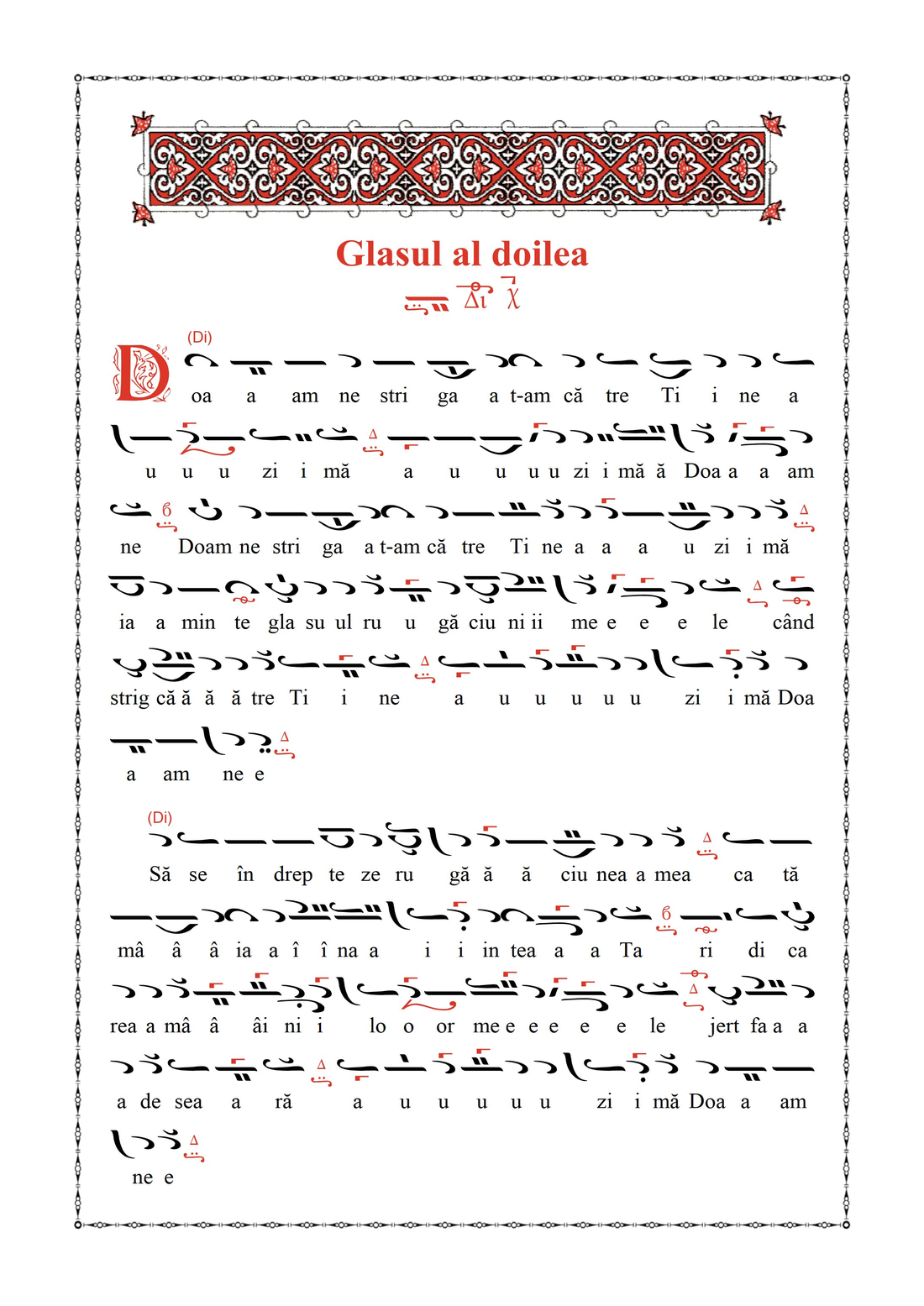
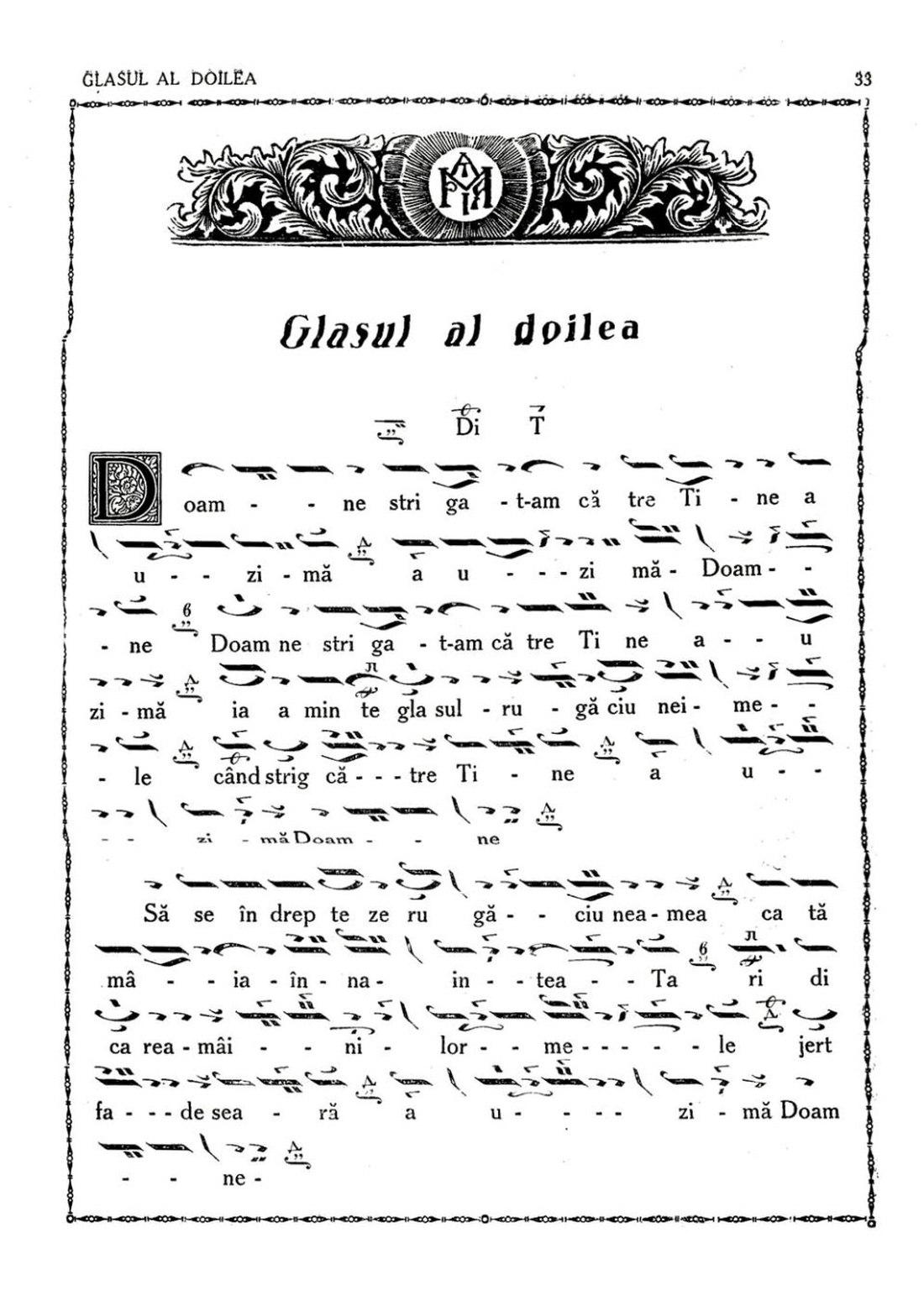 Original
Drag the comparison divider to see the same chant — the opening verses of Psalm 140, “Lord, I Have Cried” (Doamne, strigat-am), set in the second mode (Glasul al doilea) — before and after re-engraving. The source comes from the Anastasimatarion — the book of Resurrection hymns and one of the principal liturgical hymnals of the Christian Orthodox Church. On the left stands the original printing: uneven, monochrome, and visibly exhausted — not because the notation itself was poorly made, but because the page survives from an out-of-print 1943 edition that has been photocopied and re-photocopied for decades, each generation of reproduction degrading the clarity of the previous one. On the right, the same chant has been re-engraved from the ground up: evenly spaced, restored to the traditional two-colour impression, furnished with a clean ornamental header and decorative initial, and rebuilt according to the orthographic and compositional rules of Byzantine musical notation itself. The work was undertaken as part of the preparation of a new edition of that long-unavailable 1943 hymnal, so the book may once again be printed, used, and transmitted. What is shown here is not merely aesthetic restoration, but production craft in service of cultural continuity. Every spacing decision, glyph choice, alignment, and colour layer exists for a larger purpose: to keep this rare and endangered sacred chant tradition legible, chantable, and faithfully transmissible to the chanters and generations who still depend upon it. The typesetting is the means; preservation of the chant tradition is the end.
What re-engraving actually involves
Byzantine notation works on a fundamentally different principle from Western staff notation. Where the Western system is largely analytic — a note-head on a line fixes the pitch, while separate marks above and below the staff govern articulation, dynamics, and expression — Byzantine notation is synthetic. A single neume does not merely indicate a melodic interval; it intrinsically encodes the physical execution, vocal embellishment, and textual stress in one symbol, with additional marks above, below, and around the notation refining duration, modal function, and phrasing. The page therefore has to be constructed as a system of precisely registered layers — principal neumes, temporal and expressive signs, red modal signatures (martyria), ison indications, and the chant text itself — all aligned syllable by syllable across the page so that nothing collides, drifts, or obscures the reading flow. This is not a “harder” discipline than Western engraving so much as a fundamentally different one, requiring dedicated software designed specifically for Byzantine notation. The craft lies not merely in using that software, but in driving it toward a page that is visually balanced, rhythmically legible, and suitable for liturgical use.
Beyond its synthetic logic, Byzantine notation also possesses a strict orthographic system. A given melodic gesture may only be written using the sign appropriate to its surroundings: the oligon, petastē, and oxeia, for instance, all indicate an ascending second, yet each commands a distinct vocal delivery, and only one is correct in any given position. Certain ascending neumes require particular companions when followed by descending movement; some ornamental signs may appear only above accented syllables; other combinations are forbidden outright by the internal logic of the notation. To a trained chanter, selecting the wrong glyph for a given context is as visibly erroneous as misspelling a technical term — and the page may sound approximately correct while still stripping the melody of its intended phrasing and articulation. The re-engraving therefore proceeds against those rules deliberately and systematically: every glyph chosen for its proper contextual function so the page is not only visually balanced but grammatically correct — a rule-bound discipline comparable, in spirit, to technical documentation and editorial standardisation, carried here into a sacred musical script. Chant theory enters only insofar as it determines which sign is correct; the theoretical system itself is not the subject of the work.
What was produced
- Layered registration. Principal neumes, temporal and expressive signs, red martyria, ison marks, and chant text aligned as independent but synchronised layers against a common syllabic structure, ensuring stable visual registration throughout the page.
- Orthographically correct engraving. Every glyph selected according to its proper contextual function rather than visual resemblance, producing a page that is not merely readable, but correctly “spelled” according to the rules of the notation.
- Traditional two-colour impression. Black notation paired with red modal and structural markings, carefully controlled so both colour layers remain optically aligned and balanced in print.
- Book-grade page composition. Decorative header work, ornamental initials, disciplined spacing, and refined textual underlay designed to restore the appearance and dignity of a true liturgical chant book rather than a deteriorated photocopy.
A degraded 1943 out-of-print source restored to print-ready condition: layered, registered, orthographically correct, structurally balanced, and re-established in the traditional two-colour form of Byzantine chant printing. Beyond the technical accomplishment, however, the work serves something larger than engraving itself: the preservation and continued transmission of a living yet increasingly endangered sacred chant tradition through careful, disciplined, and historically faithful page-making.
Every example here is method shown through abstracted work. The real deliverables stay confidential — but the approach is exactly what travels to your project.
Start a conversation